
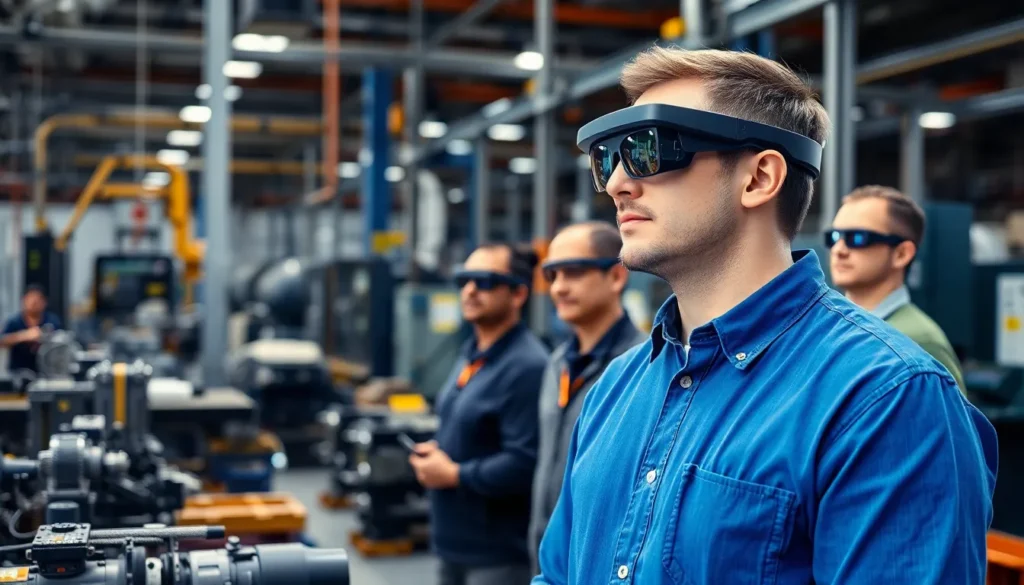
Imagine walking into a factory where the machines talk back, guiding workers like a trusty sidekick. Welcome to the world of industrial augmented reality, where the mundane transforms into the extraordinary. This cutting-edge technology isn’t just about flashy goggles; it’s about enhancing productivity and safety while making work feel like a video game.
Overview of Industrial Augmented Reality
Industrial augmented reality (AR) integrates digital elements into the physical world, enhancing interactions and processes in industrial environments. This integration significantly boosts efficiency and safety across various manufacturing and warehouse settings.
Definition and Key Concepts
Industrial augmented reality refers to technology that overlays digital information onto the real world. By using devices like smart glasses and mobile applications, workers receive visual aids as they perform tasks. Key concepts include real-time data visualization, 3D modeling, and remote collaboration. Workers can access step-by-step instructions and real-time analytics, which streamline operations. Integrating AR into industrial applications enhances clarity, reduces error rates, and fosters a culture of continuous improvement.
Historical Development
The roots of industrial augmented reality trace back to the early 1990s. Researchers began experimenting with AR for military applications, focusing on improving situational awareness. Significant milestones occurred with the introduction of see-through displays and head-mounted devices. By the 2000s, industries recognized AR’s potential in manufacturing, prompting investments in software and hardware development. Recent advancements in technologies like 5G and AI have further accelerated the adoption of AR in industrial settings, making tools more accessible and effective for diverse applications.
Applications in Various Industries
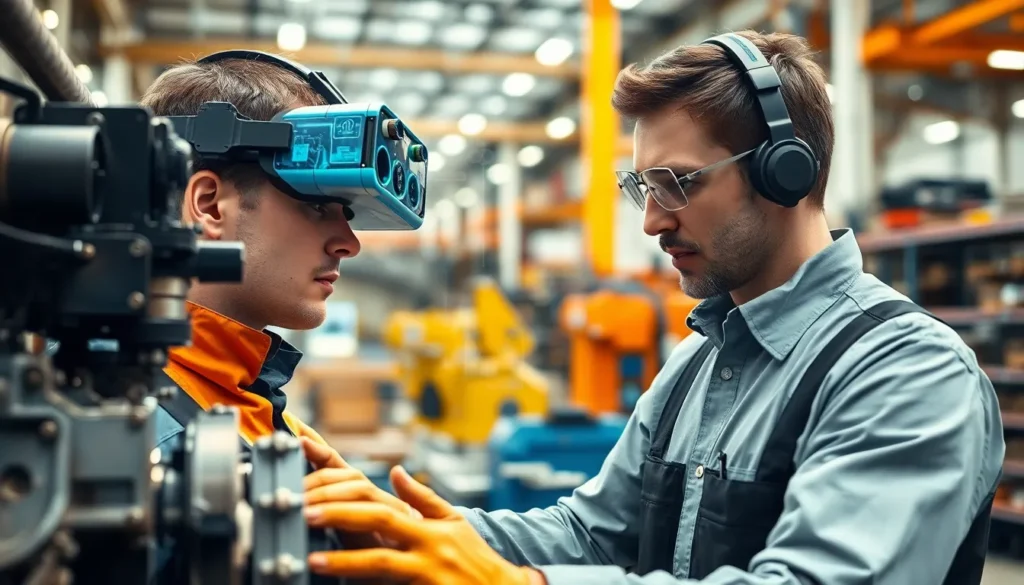
Industrial augmented reality finds applications across diverse sectors. This technology enhances operational efficiency, improves safety, and transforms workflows.
Manufacturing and Assembly
Manufacturers utilize AR to streamline assembly lines. Workers receive real-time data and visual instructions, reducing errors during assembly tasks. Companies implement AR systems for 3D modeling, enabling visual simulations that aid in design and planning. These simulations enhance collaboration between teams, allowing adjustments to be made proactively. AR headsets provide immersive experiences, where users can engage with digital overlays that guide them step-by-step. Significant improvements in productivity and accuracy occur when using AR tools in high-volume manufacturing environments.
Maintenance and Repair
Technicians rely on augmented reality for maintenance and repair tasks. AR applications provide detailed overlays of machinery, highlighting critical components. Users benefit from visual aids that offer step-by-step guidance, reducing the time spent diagnosing issues. When AR enables remote collaboration, expertise can be shared in real-time, ensuring efficient resolutions. Inspection processes become faster and more effective as technicians receive immediate feedback through AR systems. Companies report a decrease in downtime, leading to substantial cost savings in maintenance budgets.
Training and Onboarding
Augmented reality revolutionizes training and onboarding practices. New employees engage with interactive AR modules, fostering hands-on learning experiences. These modules simulate real-world scenarios, allowing users to practice skills in a safe environment. Skills retention rates improve significantly when employees learn through immersive technology. AR facilitates ongoing assessments, enabling employers to track progress effectively. Employees feel more confident and competent as they gain familiarity with workplace tools through augmented environments.
Benefits of Industrial Augmented Reality
Industrial augmented reality (AR) offers various advantages that enhance workplace productivity and safety. Companies adopting this technology experience significant transformations in operations.
Enhanced Visualization
Enhanced visualization stands out as a primary benefit of industrial AR. Workers access real-time data overlays that provide clear and vivid insights into tasks. Displays integrate seamlessly into the physical environment, making complex information easy to understand at a glance. Using smart glasses or mobile devices, employees can visualize 3D models, improving spatial awareness. Detailed graphical representations help identify potential issues before they escalate. Immediate access to vital information leads to better decision-making and reduces reliance on manual processes.
Improved Efficiency and Accuracy
Improved efficiency and accuracy emerge as critical advantages. Industrial AR minimizes errors during assembly or maintenance tasks. Workers receive visual instructions that guide them through processes step-by-step. Increased precision leads to higher-quality outputs. Downtime significantly decreases, as AR tools facilitate faster diagnostics and repairs. Through remote collaboration features, teams can troubleshoot equipment effectively without being on-site. Overall, integrating AR into workflows streamlines operations and fosters higher productivity levels.
Challenges and Limitations
Industrial augmented reality faces several challenges and limitations that can impede its widespread implementation.
Technical Constraints
Technical limitations hinder the performance of industrial AR. Hardware capabilities significantly affect usability. Devices like smart glasses may struggle with battery life and processing power during extended use. Additionally, compatibility issues arise when integrating AR systems with existing industrial equipment, complicating deployment. Network connectivity poses another challenge, as a stable and high-speed internet connection is crucial for real-time data transmission and functionality. Meeting these technical requirements remains a barrier for many organizations.
Adoption and Integration Issues
Adoption and integration issues deter companies from fully embracing industrial AR. Resistance to change often stems from employees’ reluctance to abandon traditional workflows. Training requirements add another layer of complexity, as staff needs adequate preparation to utilize AR technologies effectively. Costs associated with acquiring AR tools and integrating them into existing systems can be substantial, particularly for smaller businesses. Moreover, aligning AR strategies with overarching operational goals proves challenging, as companies strive to balance innovation with practical considerations.
Future Trends in Industrial Augmented Reality
Industrial augmented reality continues evolving rapidly. Its advancements shape various sectors, enhancing efficiency and capabilities.
Advancements in Technology
Innovative technologies drive progress in industrial AR. Integration of artificial intelligence enables more accurate data analysis and decision-making in real-time. Devices like smart glasses are becoming lighter and more affordable, enhancing user experience and accessibility. Enhanced 5G connectivity allows seamless data transmission, reducing latency and improving the accuracy of AR applications. Furthermore, software improvements lead to more intuitive interfaces, fostering user adoption and productivity. Companies consistently invest in mixed reality solutions, blending AR with virtual reality to create immersive training experiences. These advancements lay the groundwork for a more interconnected and efficient industrial landscape.
Potential Market Growth
The industrial AR market is poised for substantial growth. Research indicates a projected market size of $61.39 billion by 2023, reflecting a compound annual growth rate of 43.8%. This growth arises from increased demand for remote assistance tools and the adoption of automation in manufacturing. Industries are recognizing the need for efficient training solutions, driving up AR’s value in workforce development. Companies seeking to minimize operational downtime and enhance safety are adopting AR technologies. As more case studies demonstrate successful implementations, further investment in AR solutions is anticipated. Focused on innovation, stakeholders are accelerating AR developments, indicating a vibrant future in industrial applications.
Industrial augmented reality is reshaping the landscape of manufacturing and other sectors. By merging digital information with the physical environment, it enhances productivity and safety while fostering a culture of continuous improvement. The technology’s ability to provide real-time data visualization and interactive training modules positions it as a vital asset for companies seeking to streamline operations.
Despite facing challenges such as technical limitations and resistance to change, the future of industrial AR looks promising. As advancements in AI and connectivity continue to evolve, industries are likely to witness significant growth and innovation. Embracing industrial AR not only boosts efficiency but also prepares organizations for the demands of an increasingly digital world.


