

Imagine walking down the street and suddenly spotting a giant virtual cat lounging on a park bench. Augmented reality networks are making such whimsical encounters a reality, blending the digital world with our everyday lives. As technology leaps forward, these networks are transforming how people interact with their surroundings, creating experiences that are not only entertaining but also incredibly useful.
Overview of Augmented Reality Networks
Augmented reality networks leverage technology to create interactive experiences that integrate digital elements into the real world. Users engage with digital characters or objects, such as spotting a giant virtual cat in a park, enhancing their everyday encounters significantly. Emerging applications span various fields, including gaming, education, and retail, where AR networks enrich how information is presented.
Key components of augmented reality networks include sensors, cameras, and processors. Sensors allow devices to determine a user’s location and orientation. Cameras capture the environment, and processors analyze this data to overlay digital content seamlessly. These elements work together to deliver immersive experiences that captivate users.
Moreover, collaborative features of AR networks encourage community interaction. Users can share experiences in real-time, creating social engagement around the content. For instance, groups can participate in shared AR games, enhancing connectivity and fun among participants.
Notably, the technology behind augmented reality networks evolves rapidly. Innovations in hardware and software contribute to improved performance and reduced latency. Users experience smoother interactions, heightening the overall enjoyment and effectiveness of these applications.
Studies indicate that augmented reality networks enhance user engagement by up to 70%. This increase showcases the technology’s potential in transforming consumer experiences and interactions. As it continues to develop, augmented reality networks are positioned to revolutionize how individuals navigate their environments, offering opportunities that blend entertainment with functionality.
Applications of Augmented Reality Networks
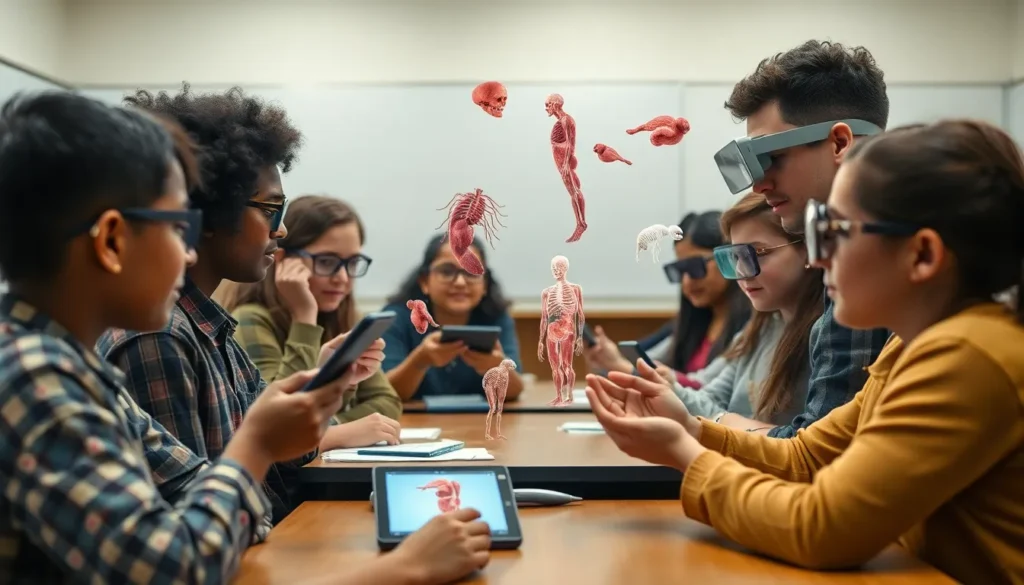
Augmented reality networks find diverse applications across various fields, showcasing their versatility and potential.
In Education
AR networks enhance educational experiences by offering interactive learning environments. Students engage with 3D models during lessons, allowing for hands-on exploration of subjects like anatomy or physics. Scientific simulations become vivid and tangible, promoting deeper understanding. Teachers use AR to create immersive storytelling sessions, capturing students’ attention effectively. Furthermore, language learning benefits from AR, enabling students to practice in real-world contexts. Through collaboration, educators share AR resources and experiences, revolutionizing traditional teaching methodologies.
In Healthcare
Healthcare professionals utilize augmented reality networks for training and surgical procedures. Medical students can rehearse complex surgeries in a simulated environment, gaining confidence before becoming hands-on. Surgeons enhance precision as AR overlays vital information during operations, minimizing risks. Patient education improves with AR visualizations, helping individuals understand procedures and conditions thoroughly. Rehabilitation programs leverage AR to motivate patients while tracking progress. Real-time data sharing among professionals fosters collaboration, ultimately improving patient outcomes.
In Entertainment
The entertainment industry leverages augmented reality networks to create immersive experiences. Gamers explore virtual worlds layered over real environments, leading to increased engagement. Concert-goers enjoy AR-enhanced performances, with interactive visuals complementing music. Filmmakers employ AR for innovative storytelling, blurring lines between reality and imagination. Event organizers integrate AR elements, allowing attendees to visualize content actively. Social media platforms enable users to share AR moments, enriching personal connections and experiences.
Technical Framework of Augmented Reality Networks
The technical framework of augmented reality networks plays a critical role in delivering immersive experiences. It combines various elements that allow users to interact with digital content in real time.
Network Architecture
Network architecture consists of multiple layers that facilitate seamless data transmission. At the base, edge computing reduces latency by processing data closer to the user. Next, local servers handle requests, allowing rapid access to AR content. Cloud infrastructure also supports heavy data storage and processing tasks, enabling scalability. Each layer works together to maintain a stable and efficient user experience.
Key Technologies
Key technologies underpinning augmented reality networks include sensors, computer vision, and 3D rendering. Advanced sensors detect user movements and environmental changes, enhancing immersion. Computer vision algorithms analyze images and recognize objects, ensuring accurate overlays. Furthermore, 3D rendering creates realistic graphics that integrate seamlessly with the real world. These technologies collectively enhance engagement and interaction within AR networks, transforming user experiences.
Challenges and Limitations
Augmented reality networks face several challenges that affect their widespread adoption. High hardware costs hinder accessibility for many users, limiting participation to those who can afford advanced devices. Latency issues still pose significant barriers, as delays in data transmission disrupt user experiences and immersion. Content availability also remains a concern; many AR applications lack diverse, engaging content, making it difficult to maintain user interest over time.
Network connectivity impacts performance, as stable and fast internet connections are crucial for seamless experiences. Inadequate infrastructure may result in unstable connections, affecting the reliability of AR interactions. Privacy concerns arise as AR networks often require data collection, raising questions about user consent and data security. Users may hesitate to engage with AR technologies if they fear their personal information could be compromised.
User experience can suffer from usability issues, especially for those unfamiliar with AR technology. Complicated interfaces or difficult onboarding processes deter potential users. Additionally, the physical environment can limit the effectiveness of augmented reality experiences; crowded or cluttered spaces may hinder proper functioning of AR applications. Environmental factors such as lighting conditions or obstacles can create discrepancies in how virtual and real-world elements interact.
Standardization in the industry also lags. Without a coherent framework, developers may find it challenging to create cross-compatible applications, leading to fragmented user experiences. Visual fatigue can result from prolonged use of AR devices, where users may experience discomfort or strain. Addressing these challenges is essential for the future development of augmented reality networks, ensuring their potential is fully realized and accessible to a broader audience.
Future Trends in Augmented Reality Networks
Augmented reality networks are on the brink of significant advancements that will reshape user experiences. Emerging technologies such as 5G connectivity play a crucial role in enabling faster data transmission, reducing latency to nearly negligible levels. Enhanced user interactivity fosters deeper engagement, making experiences more immersive and meaningful.
In the gaming sector, sophisticated AR experiences will become more prevalent, transforming how players engage with environments. By integrating AI with augmented reality, personalized interactions will enhance user satisfaction and retention. Diverse applications in retail are set to flourish, allowing shoppers to visualize products in their environment before purchasing.
Healthcare is poised for a revolution, with AR networks improving medical training and patient diagnostics through real-time visualizations. Educational institutions are adopting AR to create interactive lessons that capture student interest and encourage active participation.
Furthermore, advancements in sensors and computer vision will facilitate seamless navigation and object recognition in real-world settings. Simplified interfaces will combat usability issues, making technology accessible to a broader demographic.
Significantly, the move towards industry standardization will address fragmentation, promoting a cohesive user experience across various platforms. As privacy concerns continue to surface, responsible data use strategies will build trust among users.
Sustainable innovations will also gain momentum, as AR networks harness eco-friendly technologies to minimize environmental impact. The integration of virtual and augmented reality will blur the lines between digital and physical worlds, offering vast opportunities for creativity and collaboration across industries.
Augmented reality networks are redefining how individuals interact with their surroundings. By merging digital elements with the real world they create engaging experiences that enhance both entertainment and functionality. As technology continues to advance the potential applications across various industries are immense.
Challenges remain in terms of accessibility and user experience but ongoing innovations promise to address these issues. With the rise of 5G connectivity and improved sensor technologies the future looks bright for AR networks. They’re not just a passing trend; they’re set to become integral to everyday life as they transform education healthcare and retail.
As these networks evolve they hold the key to a more interactive and immersive world. Embracing this technology will unlock new possibilities for creativity collaboration and engagement across all aspects of life.


