

Imagine strolling through your favorite art gallery and suddenly, the paintings leap off the canvas, inviting you to join their colorful world. That’s the magic of augmented reality images. They blend the digital and physical realms, transforming ordinary experiences into extraordinary adventures.
With augmented reality, everyday moments turn into interactive escapades. Whether it’s a quirky cat that pops up in your living room or a historical figure giving you a tour of the past, AR images are redefining how people perceive their surroundings. It’s not just tech; it’s a ticket to a whimsical universe where imagination knows no bounds.
Understanding Augmented Reality Images
Augmented reality images enhance the real world by overlaying digital content. This technology integrates visual elements into the user’s environment, creating a unique and interactive experience.
Definition and Concept
Augmented reality images blend digital visuals with the physical world. These images can include anything from 3D models to animations. Often, users interact with these images through devices like smartphones and AR glasses. For example, a user might view a virtual dinosaur in their backyard or see product details while shopping. The technology analyzes real-time data to position these images precisely, ensuring a seamless fusion of reality and digital representation.
How It Differs from Virtual Reality
Virtual reality immerses users completely in a digital environment. Unlike augmented reality, virtual reality typically requires headsets that block out the real world. In augmented reality, users see and engage with both digital elements and their surroundings simultaneously. The interactive layers provided by AR enhance everyday experiences without replacing the user’s physical environment. Additionally, AR maintains a connection to reality, while VR offers an escape into a fully imagined world.
Applications of Augmented Reality Images

Augmented reality images find applications across various sectors. These images enhance experiences by providing interactive elements in both practical and entertaining ways.
In Gaming and Entertainment
Gaming often utilizes augmented reality images to create immersive experiences. Players interact with virtual characters and environments superimposed on the real world. Pokémon GO exemplifies this, allowing users to capture virtual creatures in their physical locations. Entertainment events incorporate AR, enhancing viewer engagement through live shows that feature interactive elements. These strategies keep audiences captivated by bridging the gap between the physical and digital realms.
In Education and Training
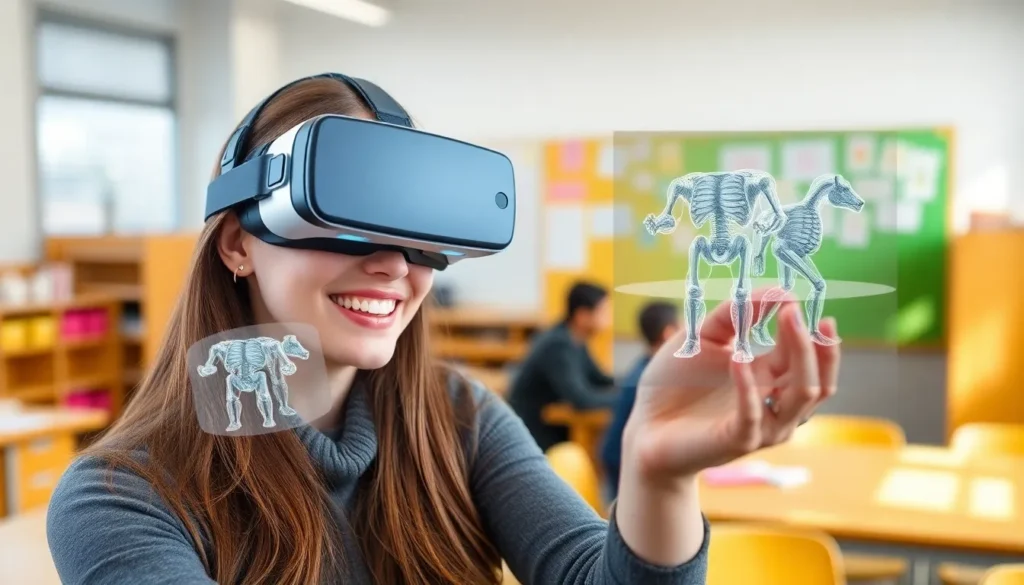
Education leverages augmented reality images to deliver engaging learning experiences. Students can visualize complex concepts through 3D models, making science and history more tangible. Platforms like Google Expeditions enable users to explore historical sites and dive into the human anatomy interactively. Training programs in industries such as medicine and aviation adopt AR to simulate real-world scenarios safely. These applications help users retain information and develop skills in a controlled environment.
In Advertising and Marketing
Advertising frequently employs augmented reality images to create memorable brand interactions. Brands allow customers to visualize products in their homes before purchasing. Companies like IKEA have developed AR apps that let users see furniture in their spaces. This direct engagement boosts conversion rates and enhances customer satisfaction. Additionally, interactive ads entice consumers, making marketing campaigns more engaging and effective.
Creating Augmented Reality Images
Creating high-quality augmented reality images involves specific tools and techniques that enhance user engagement and interaction. These tools simplify the process and enable developers to bring imaginative concepts to life.
Tools and Software
Numerous tools exist for crafting augmented reality images. Popular software includes Unity, a powerful game engine that supports AR development, and Vuforia, which specializes in image recognition. Additionally, ARKit and ARCore are essential for developers focused on iOS and Android, respectively. Consider using Spark AR Studio for social media applications, as it allows users to create AR content for platforms like Instagram and Facebook. Each tool offers unique functionalities that cater to different aspects of AR development.
Best Practices for Quality Images
Quality plays a crucial role in creating effective augmented reality images. Start by ensuring images are high-resolution, as sharp visuals enhance the user experience. Next, incorporate 3D models that are optimized for performance, reducing load times and improving interactions. Maintain a consistent style that aligns with the overall theme of your project, which helps in creating a cohesive user experience. Ensure the digital content interacts realistically with the physical environment, allowing for smooth overlays and better engagement. Lastly, test the images across various devices to guarantee compatibility and performance, ultimately refining user satisfaction.
Future Trends in Augmented Reality Images
Augmented reality images are evolving rapidly, with trends emerging that will shape their future in multiple sectors.
Innovations on the Horizon
Innovations in augmented reality images promise to enhance user experiences significantly. Advanced machine learning algorithms will improve object recognition in real time, enabling seamless interactions. Hardware advancements will lead to lighter, more comfortable AR glasses, allowing users to immerse themselves for extended periods. Integration with IoT devices will provide contextual information, overlaying relevant data on physical objects. Companies are also exploring hand-tracking technology, making interactions more intuitive and natural. Additionally, the expansion of 5G will allow for higher data transmission speeds, improving responsiveness and reducing latency in AR applications.
Potential Challenges
Challenges in augmented reality images present obstacles for developers and users alike. Limitations in hardware affordability may restrict access for many consumers and small businesses. Privacy and security concerns will intensify as AR becomes more integrated into daily life, raising issues about data collection and user consent. Compatibility across various devices also poses a challenge, as inconsistent performance can hinder user experience. Additionally, content creation remains complex; producing engaging AR experiences requires significant resources and expertise. Developers need to navigate these challenges to deliver high-quality, user-friendly AR applications effectively.
Augmented reality images are reshaping how people interact with their environment. By blending digital content with the physical world, they open up endless possibilities for creativity and engagement. As technology advances, the potential for AR continues to grow, promising more immersive experiences across various fields.
The future holds exciting innovations that could further enhance user interactions. However, challenges remain that developers need to address to ensure seamless integration and user satisfaction. As AR evolves, it’s clear that its impact will be felt in everyday life, transforming ordinary moments into extraordinary adventures.


