

Imagine walking through a museum where the paintings come to life, or trying on clothes without stepping into a fitting room. Augmented reality (AR) isn’t just for gamers anymore; it’s transforming how we interact with the world. With a sprinkle of digital magic, AR enhances everyday experiences, making them more engaging and informative.
Understanding Augmented Reality
Augmented reality integrates digital elements into the real world, enhancing users’ perceptions of their environment. It overlays images, sounds, and other sensory stimuli on top of physical spaces, creating interactive experiences. Industries like retail, education, and healthcare increasingly utilize AR to improve user engagement and deliver innovative solutions.
Within retail, virtual fitting rooms allow customers to try on clothes without being physically present, enhancing the shopping experience. Studies show that 61% of consumers prefer stores that offer AR experiences. In education, AR transforms learning by providing 3D models and simulations that illustrate complex concepts, making them easier to grasp.
Healthcare also benefits significantly from AR applications. Surgeons harness AR technology to visualize critical information during procedures, boosting precision and reducing risks. Research indicates that AR training programs can enhance retention rates among medical students by up to 45%.
Real estate professionals use AR to create virtual tours of properties, enabling potential buyers to explore homes from anywhere. This technology cuts down on time and resources spent on in-person viewings. The entertainment industry, too, employs AR to engage audiences in ways that traditional media cannot, further blurring the lines between physical and digital realms.
Examples of popular AR applications abound, ranging from interactive gaming experiences to navigation aids that provide real-time directions. The widespread adoption of AR-enhanced smartphones ensures that users access immersive experiences anytime. Overall, augmented reality continues to redefine how people interact with information and their surroundings in profound ways.
Benefits of Augmented Reality in Education
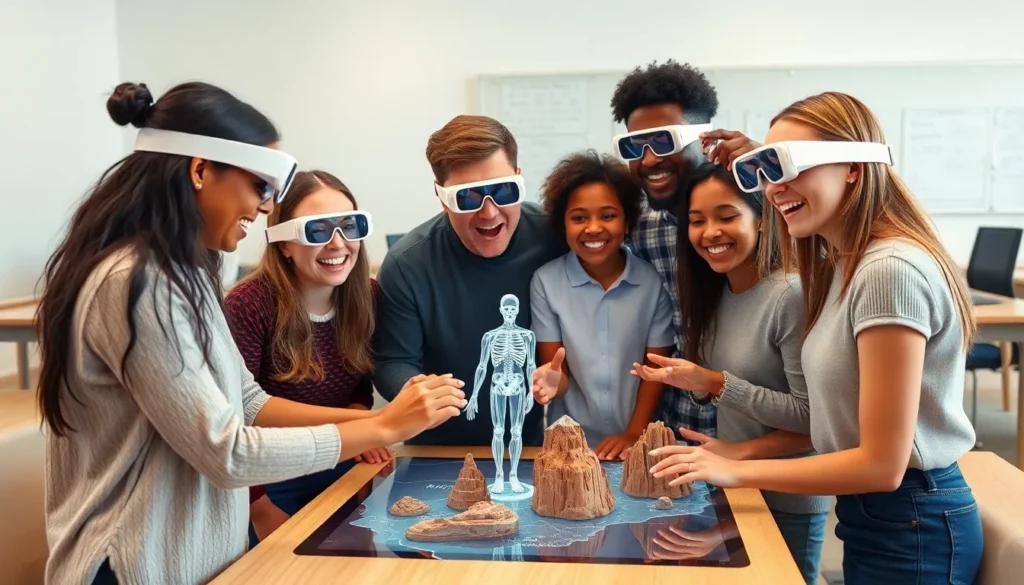
Augmented reality revolutionizes education through immersive learning and interactive technology. This innovative method enables educational institutions to deliver richer content to students.
Enhanced Learning Experiences
AR technology presents 3D models alongside traditional materials. Students visualize complex concepts, such as human anatomy, geological formations, or historical events. Understanding improves significantly when students can manipulate these virtual objects. Schools using AR report a 70% increase in information retention, demonstrating its effectiveness. Moreover, hands-on experiences foster critical thinking and problem-solving skills.
Increased Engagement
Engagement levels skyrocket with the integration of AR into lessons. Learners actively participate in unique activities rather than passively absorbing information. In fact, studies indicate that 65% of educators find AR increases student motivation. Games and interactive challenges enhance curiosity and make learning enjoyable. The ability to explore subjects in a dynamic environment captivates students’ attention and fosters collaboration. Enhanced teamwork occurs through shared AR experiences, encouraging communication among peers.
Benefits of Augmented Reality in Business
Augmented reality significantly enhances business operations and customer interactions. Its implementation yields noteworthy advantages across various sectors.
Improved Customer Experience
Enhanced customer experiences result from AR technology. Retailers employ virtual fitting rooms, allowing customers to visualize clothing fit before purchase. Approximately 61% of consumers express a preference for stores that offer AR experiences. Interactive in-store displays engage shoppers more effectively. Educational platforms use AR to create immersive learning experiences, which boost retention rates by 70%. Additionally, users of AR apps often report higher satisfaction as they interact with products in their own environments. Engaging visuals influence purchasing decisions, making AR an invaluable tool for modern businesses.
Streamlined Operations
Businesses notice streamlining operations with AR applications. In healthcare, surgeons utilize AR for visualizing complex procedures, improving accuracy. This technology minimizes risks during critical surgeries. Real estate companies also benefit from virtual property tours, saving time for agents and potential buyers. Increased efficiency accompanies AR-enhanced logistics systems, enabling workers to track inventory in real time. By reducing operational bottlenecks, businesses can allocate resources more effectively. Overall, AR fosters greater productivity and operational agility in various industries.
Benefits of Augmented Reality in Healthcare
Augmented reality (AR) significantly enhances various aspects of healthcare, improving patient experiences and outcomes while revolutionizing training protocols.
Better Patient Outcomes
AR technology enables surgeons to access critical information during procedures. By overlaying digital images onto the surgical field, it enhances visualization of anatomy, which improves precision. Studies show that using AR can reduce surgical complications, leading to faster recovery times for patients. Enhanced engagement with AR tools also aids patients in understanding their conditions better, fostering informed decision-making in treatment plans. When healthcare professionals utilize AR, patient satisfaction correlates positively with clinical performance metrics.
Training and Simulation
Augmented reality revolutionizes medical training through realistic simulations. Trainees can practice complex procedures in immersive environments without risks associated with real-life scenarios. This method accelerates skill acquisition and builds confidence among healthcare practitioners. Research indicates that AR can increase knowledge retention rates during training by up to 70%. Instructors use AR to demonstrate intricate techniques, allowing immediate feedback and correction. Engaged learners often exhibit improved critical thinking and problem-solving abilities through practical application, effectively preparing them for real-world challenges.
Benefits of Augmented Reality in Retail
Augmented reality (AR) significantly transforms retail experiences by enhancing customer engagement and satisfaction. Retailers increasingly adopt AR technology to meet evolving consumer expectations.
Virtual Try-Ons
Virtual try-ons allow customers to see how clothing or accessories look before purchasing. Many consumers find this technology appealing, with reports indicating that 61% prefer retailers offering AR-enabled experiences. Such tools eliminate the inconvenience of returns and improve fit accuracy. Shoppers use smartphones or AR mirrors to visualize how products complement their appearance. Brands that utilize virtual try-ons often see increased sales and reduced return rates, making it a win-win for both retailers and consumers.
Interactive Shopping Experiences
Interactive shopping experiences captivate customers by merging the physical and digital realms. Storefronts feature displays that employ AR to provide product information and promotions. Shoppers can interact with products through their devices, gaining insights into features that influence buying decisions. Retailers report that these interactive elements enhance customer satisfaction and engagement, ultimately leading to increased foot traffic and sales. Engaging elements like gamification and exclusive content further encourage exploration, enriching the overall shopping journey.
Augmented reality is revolutionizing the way people interact with their environments. Its applications span various industries from retail to healthcare and education, enhancing user experiences and engagement. As AR technology continues to evolve, it’s clear that its potential to improve productivity and customer satisfaction is immense.
By integrating digital elements into everyday life, AR not only enriches learning and shopping experiences but also streamlines operations across businesses. The ongoing adoption of AR promises to create more immersive and interactive environments, ultimately transforming how individuals connect with the world around them. Embracing this technology will be crucial for those looking to stay ahead in an increasingly digital landscape.


